
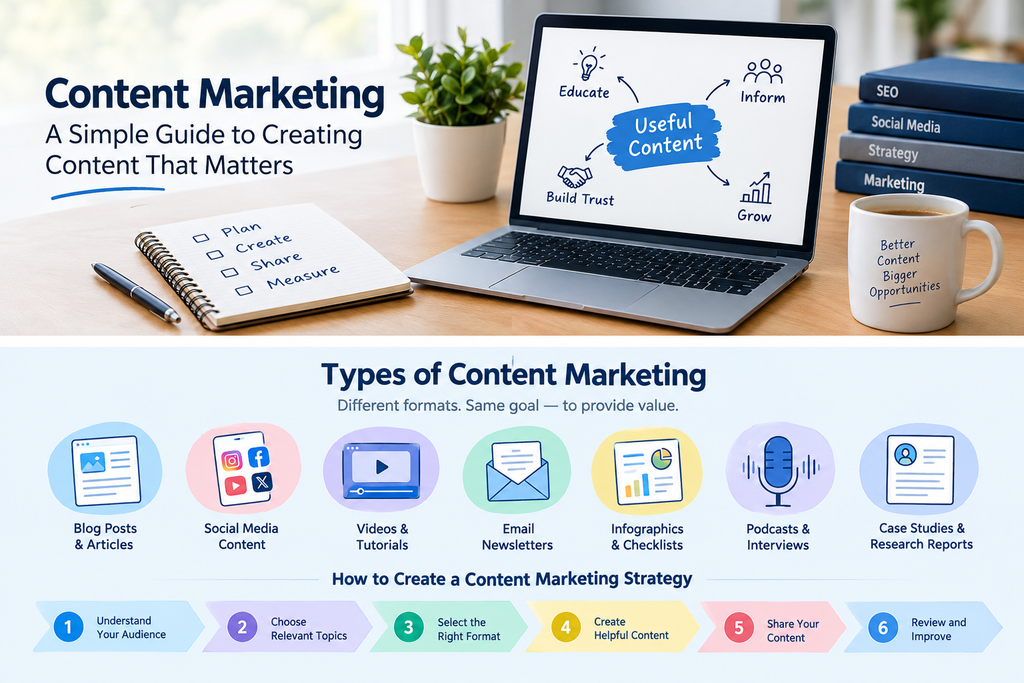
Introduction
Every day, people search online for answers, watch videos, read articles, and explore social media before making decisions. For businesses, this creates an opportunity to provide useful information and connect with the right audience.
This is where content marketing comes in.
Content marketing is not just about publishing blog posts or uploading social media updates. It is about understanding what people need and creating content that helps them. A useful article, an informative video, or a simple tutorial can answer questions and make a complicated topic easier to understand.
In this guide, we will explore how content marketing works, the different types of content, and how to create a practical content plan.
What Is Content Marketing?
Content marketing is the process of creating and sharing useful, relevant information with a specific audience.
Instead of directly asking people to buy something, it focuses on educating, informing, or helping them. The idea is to offer value through content that addresses real questions and problems.
For example, a bakery could publish a blog about choosing the right cake for different occasions. A clothing store could share tips on matching colours or selecting outfits for a job interview.
Both examples provide information that readers can use in their everyday lives.
Common types of content marketing include:
- Blog posts and articles
- Social media posts and short videos
- Educational guides and tutorials
- Email newsletters
- Infographics and checklists
- Podcasts and interviews
- Case studies and research reports
The best format depends on the audience, the topic, and the resources available.
Why Is Content Marketing Important?
People often look for information before choosing a product, service, or business. Helpful content can make that research easier and help readers understand their options.
Here are some important benefits of content marketing.
1. It Helps People Find Information
A well-written article can answer questions that people are already searching for online. If the information is relevant and easy to understand, readers may discover it through search engines.
2. It Builds Trust
Readers are more likely to value content that answers their questions honestly. Providing useful information without making exaggerated claims can help build credibility over time.
3. It Improves Online Visibility
Publishing relevant content gives a website more opportunities to appear in search results for different topics. However, publishing alone does not guarantee rankings. Content must be useful, relevant, and accessible to search engines.
4. It Keeps People Engaged
Different people prefer different ways of learning. Some enjoy reading detailed articles, while others prefer videos, images, or short explanations. Offering suitable formats can make information easier to understand.
5. It Provides Long-Term Value
A useful article may continue attracting readers months after publication. Updating it when information changes can help keep it relevant.
Different Types of Content Marketing
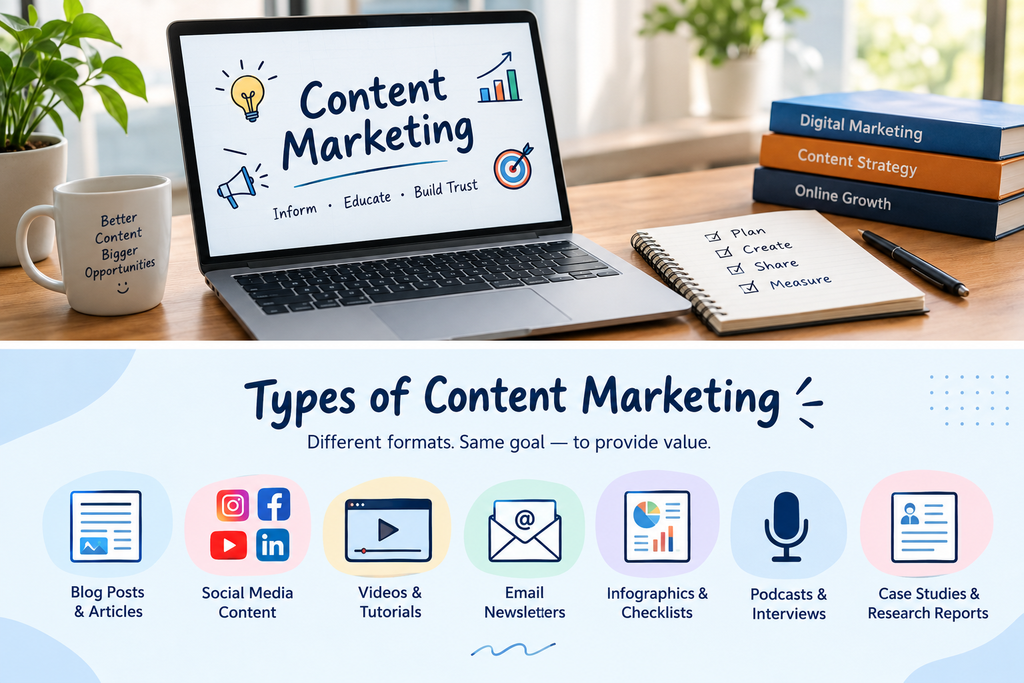
There is no single format that works for every business. Understanding the main options makes it easier to choose what suits your audience.
Blog Posts and Articles
Blogs are useful for explaining topics in detail. They can answer common questions, provide step-by-step instructions, and discuss problems that readers want to solve.
For example, an article titled “How to Prepare for Your First Job Interview” gives readers practical advice they can apply.
Social Media Content
Social media allows businesses and creators to share short, accessible information. Tips, simple graphics, short videos, and question-and-answer posts are common examples.
The content should fit the platform and provide something useful rather than simply filling a posting schedule.
Videos and Tutorials
Videos are particularly helpful when a process is easier to demonstrate than explain in writing. Screen recordings, product demonstrations, and educational videos can make complicated tasks easier to follow.
Email Newsletters
Newsletters allow people to receive useful information directly in their inbox. They may include new articles, practical tips, updates, or selected resources.
Messages should be relevant to subscribers and respect their communication preferences.
Infographics and Checklists
Infographics present information visually, while checklists help people complete tasks. Both formats can make complex information easier to scan and remember.
How to Create a Simple Content Marketing Strategy
A content strategy does not need to be complicated. A clear plan can help you create more relevant content and avoid wasting time.
Step 1: Understand Your Audience
Start by identifying the people you want to reach.
Think about their interests, common questions, goals, and challenges. You can learn about these through customer conversations, comments, frequently asked questions, and search queries.
The better you understand your audience, the easier it becomes to choose useful topics.
Step 2: Choose Relevant Topics
Make a list of questions your audience might ask.
For example, a small business owner might want to know how to create a website, improve local visibility, or use social media effectively.
Each question could become a blog post, video, or short educational post.
Choose topics that you can explain accurately and meaningfully.
Step 3: Select the Right Format
Consider how your audience prefers to consume information.
A detailed process may work best as a blog post or tutorial. A quick tip might be more suitable for a short video or social media graphic.
You do not need to use every format. Start with one or two that you can manage consistently.
Step 4: Create Helpful Content
Focus on answering the reader’s question clearly.
Use simple language, relevant examples, descriptive headings, and short paragraphs. Check facts before publishing, and add your own observations or experience where appropriate.
Avoid unnecessary repetition and exaggerated promises. The purpose is to help readers understand the topic, not simply to make the content longer.
Step 5: Share Your Content
Publishing is only one part of the process. People also need opportunities to discover what you have created.
Depending on the topic, you can share content through search engines, relevant social media platforms, newsletters, or online communities where sharing is permitted.
Choose channels that your audience actually uses instead of trying to be present everywhere.
Step 6: Review and Improve
Look at how people interact with your content. Identify which topics attract relevant visitors, answer questions, or encourage meaningful engagement.
Use these observations to improve existing content and plan future topics.
A content strategy should develop as you learn more about your audience.
How SEO Supports Content Marketing
Search engine optimization (SEO) helps search engines understand a page and helps people discover relevant information.
Content marketing and SEO work well together, but they serve different purposes. Content provides the information, while SEO helps make that information easier to find.
Some useful practices include:
- Use a clear, descriptive page title.
- Organize information with relevant headings.
- Include keywords naturally where they fit.
- Write content that answers the reader’s question.
- Add descriptive alternative text to meaningful images.
- Link to related pages when they provide additional value.
- Check that pages work well on mobile devices.
- Review older articles and update outdated information.
Avoid repeating the same keyword excessively. Content should read naturally and be created primarily for people.
Good SEO practices can improve discoverability, but they cannot guarantee a particular ranking or amount of traffic.
Common Content Marketing Mistakes to Avoid
Even a well-planned strategy can become ineffective when the focus shifts from helping readers to simply producing more content.
Watch out for these common mistakes:
Creating content without a clear purpose: Every article or post should address a relevant question, interest, or need.
Copying competitors: Competitor research can help identify useful topics, but copying their wording or structure does not provide readers with a fresh perspective.
Publishing inconsistently: A realistic publishing schedule is more manageable than an ambitious plan that quickly becomes difficult to maintain.
Ignoring content quality: Grammar, accuracy, readability, and useful examples all affect the reader’s experience.
Focusing only on views: High traffic does not automatically mean the content is useful. Consider engagement, relevant visits, and whether readers find the information they need.
Forgetting to update old content: Outdated information can confuse readers. Review important articles periodically and correct anything that is no longer accurate.
How to Measure Content Marketing Performance
The right measurements depend on what you want your content to achieve.
For example:
- Website traffic: Shows how many visitors reach your content.
- Search impressions and clicks: Help you understand how pages appear and perform in search results.
- Engagement: Includes meaningful interactions, such as comments, shares, and video watch time.
- Email subscriptions: Indicate how many people choose to receive further information.
- Conversions: Track useful actions, such as completing a form or downloading a resource.
Tools such as Google Analytics and Google Search Console can help you review relevant website and search performance data.
Check your results regularly, but avoid judging a strategy from a single post or a short period. Different topics and formats may take different amounts of time to show results.
Conclusion
Content marketing is about creating information that people genuinely find useful. It combines audience research, thoughtful planning, clear writing, suitable distribution, and regular improvement.
You do not need to publish content every day or use every available platform. Start by understanding your audience, choose a few relevant topics, and create content that answers real questions.
Over time, pay attention to what readers find helpful and improve your approach accordingly. A simple, consistent strategy built around useful information is a much stronger foundation than publishing content simply for the sake of staying active.
Frequently Asked Questions
1. What is the main purpose of content marketing?
Its main purpose is to provide useful information to a specific audience, build trust, and support longer-term goals through relevant content.
2. Is content marketing suitable for small businesses?
Yes. Small businesses can use blogs, social media posts, videos, and guides to answer customer questions and share their knowledge without needing to use every marketing channel.
3. How often should I publish content?
There is no universal schedule. Choose a frequency that allows you to maintain quality and consistency with the time and resources available.
4. Does content marketing help SEO?
Useful, relevant content can help search engines understand a website’s topics and give people more opportunities to discover its pages. Rankings are not guaranteed and depend on multiple factors.
5. How can I find content ideas?
Start with common customer questions, search queries, discussions in relevant communities, and topics that people frequently find confusing.
6. How do I know whether my content is working?
Review metrics related to your goals, such as relevant website visits, search clicks, engagement, subscriptions, or completed actions. Use the results to identify areas for improvement.